
Ireland’s Short-Term Rental Market: What Eurostat Reveals — and What the Statistics Cannot Tell Us About Housing
A Statistical Assessment of Platform-Booked STR Accommodation, Tourism Demand, Regional Differences and Implications for Housing Regulation
Commissioned by: Irish Self Catering Federation
Date: November 2026
Executive Summary
Ireland’s short-term rental (STR) market is frequently discussed in the context of housing shortages, with increasing tourism activity sometimes interpreted as evidence of a growing number of residential properties being used for short-term accommodation. However, Eurostat’s detailed statistics on STR accommodation booked through online platforms reveal a considerably more complex picture.
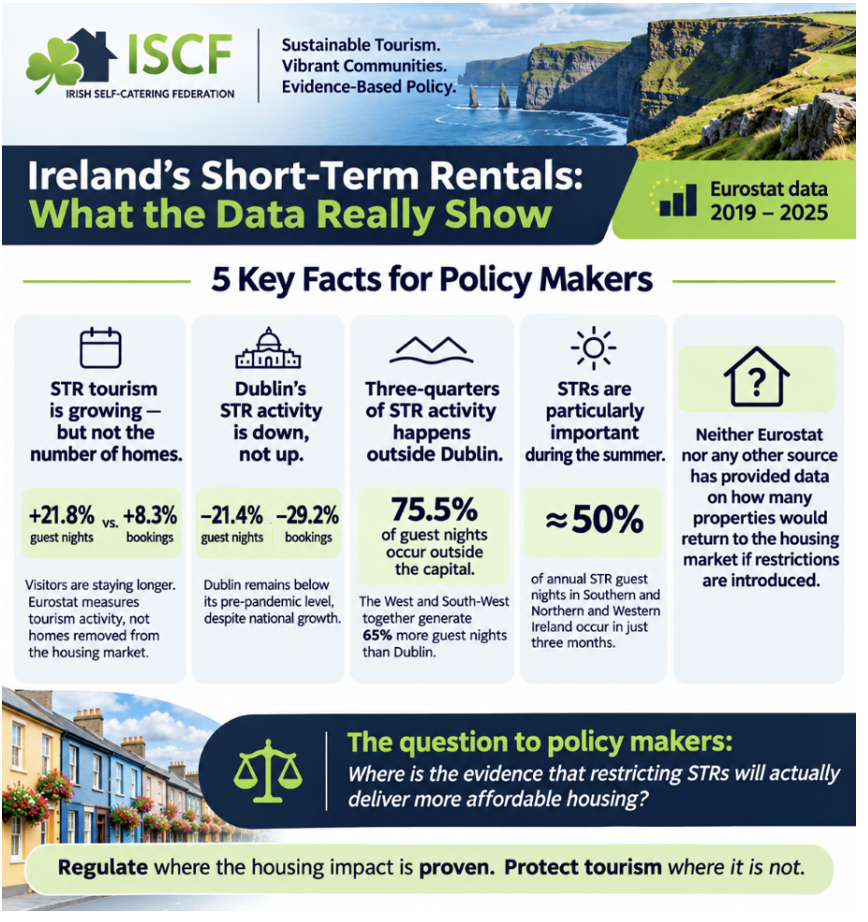
In 2025, Ireland recorded approximately 8.42 million platform-booked guest nights, representing an increase of 21.8% compared with 2019, the last full year before the COVID-19 pandemic. Yet the number of bookings increased by only 8.3% over the same period. This difference reflects changes in how accommodation is used: average booking duration increased from 2.77 to 3.07 rented nights, while the average number of guests per rented night increased only marginally.
Consequently, growth in STR guest nights cannot be interpreted as equivalent growth in the number of STR properties. Eurostat’s platform statistics measure STR accommodation activity rather than the number of unique STR accommodation units. They therefore cannot establish whether increased demand has been accommodated through existing properties, additional properties or a combination of both.
The geographical distribution of demand is equally revealing. Approximately 75.5% of Ireland’s platform-booked STR guest nights occur outside Dublin. The West and South-West together generate approximately 3.40 million guest nights annually, considerably more than Dublin’s 2.06 million.
Moreover, Dublin remains the only Irish NUTS 3 region where platform-booked guest nights have not recovered to their pre-pandemic level. In 2025, Dublin recorded 21.4% fewer guest nights and 29.2% fewer bookings than in 2019. By contrast, the rest of Ireland recorded a 48.2% increase in guest nights over the same period.
These contrasting trends demonstrate that national STR growth cannot be treated as representative of developments in Dublin or individual regional markets.
The composition of demand has also changed. Although international visitors continue to account for approximately 73% of guest nights, the number of international bookings in 2025 remained marginally below its 2019 level. International guest nights increased because theaverage stays became longer. Domestic bookings, meanwhile, increased by 38.8%, indicating substantial growth in the use of platform STR accommodation by Irish residents travelling within Ireland.
Monthly statistics reveal further differences. Almost half of annual platform-booked guest nights in Southern and Northern and Western Ireland occur during the summer months, compared with approximately 38% in Eastern and Midland. These variations demonstrate that regions with broadly comparable annual demand may have significantly different seasonal accommodation needs.
The characteristics of accommodation also warrant attention. Almost 90% of platform-booked STR guest nights occur in units with fewer than ten bed places. However, this describes accommodation capacity, not ownership or business size, and cannot be used to determine the proportion of family hosts or independent operators.
Taken together, these findings establish that Ireland’s STR market is geographically diverse, strongly seasonal in certain regions and changing in ways that headline guest-night totals do not adequately capture.
They also reveal a fundamental limitation in the evidence commonly used to discuss the housing implications of STRs. Eurostat measures tourism activity but does not identify how many residential dwellings are used for STRs, how many would otherwise be available for long-term occupation or how many would return to the residential market following restrictions.
This distinction is central to assessing the effectiveness and proportionality of Ireland’s regulatory approach.
The relevant housing-policy question is not how many guest nights STRs generate, but how many additional long-term homes particular restrictions can realistically deliver, in which locations and at what economic cost.

Understanding Ireland’s STR Market Through Eurostat
A meaningful assessment of Ireland’s short-term rental market requires a clear understanding of what the available statistics measure and, equally importantly, what they do not.
Eurostat collects information on tourism accommodation through two principal statistical systems. The first comprises conventional tourist-accommodation statistics, which cover establishments such as hotels, holiday accommodation and camping facilities. The second consists of STR accommodation-booking statistics derived from participating online platforms, including Airbnb, Booking.com and Expedia Group.
The platform statistics are particularly valuable because they capture actual STR accommodation activity rather than simply the number of properties advertised online. They provide information on stays, rented nights, guest nights, visitor origin, accommodation characteristics and geographical distribution.
Within the European classification of economic activities, known as NACE, hotels and similar accommodation fall under category 55.1, while holiday and other short-stay accommodation falls under category 55.2. Camping and caravan accommodation is classified separately under category 55.3.
The platform STR accommodation statistics concern short-stay accommodation within the scope of NACE 55.2. However, not all accommodation classified under NACE 55.2 consists of privately operated residential STRs. The category also includes other holiday and short-stay accommodation establishments.
Equally, conventional accommodation statistics and platform-STR booking statistics do not cover identical statistical populations. Some accommodation booked through platforms may also be included in conventional accommodation reporting, while other accommodation may not be fully represented.
Consequently, these datasets should be treated as complementary sources rather than added together to produce a single total. Combining them without accounting for their overlap would risk double counting.
A second distinction concerns the indicators used to measure tourism activity.
Eurostat reports the number of stays, rented nights and guest nights. These indicators describe different aspects of accommodation use and should not be treated as interchangeable.
For example, a family of four staying in a holiday apartment for three nights generates one stay, three rented nights and twelve guest nights. The same apartment can generate additional guest nights through longer stays, more bookings or larger groups, without any additional accommodation unit entering the market.
Guest nights therefore measure the volume of accommodation consumed by visitors. They do not measure the number of properties supplying that accommodation.
Similarly, the number of bookings is not equivalent to the number of accommodation units, since the same property may receive multiple bookings throughout the year.
These distinctions are fundamental when discussing STRs in relation to housing availability. Neither guest nights nor bookings establish how many dwellings are being used for short-term accommodation, how frequently they are available or whether they would otherwise be occupied by long-term residents.
Ireland’s STR Market Has Grown, but Not in the Way Headline Figures Suggest
Ireland’s platform-booked STR accommodation market recorded 8,419,318 guest nights in 2025, compared with 6,911,663 in 2019. This represents growth of 21.8%, equivalent to approximately 1.51 million additional guest nights over six years.
At first glance, this could be interpreted as evidence of substantial expansion in the STR market. However, examining the underlying booking statistics produces a more nuanced picture.
Between 2019 and 2025, the number of recorded stays increased from 815,912 to 883,762, representing growth of only 8.3%. Over the same period, rented nights increased from approximately 2.26 million to 2.72 million, or 20.3%.
The difference between these growth rates is revealing.
Average booking duration increased from 2.77 rented nights in 2019 to 3.07 in 2025, an increase of approximately 11%. By comparison, the average number of guests per rented night changed relatively little, from approximately 3.06 to 3.10.
These figures demonstrate that the increase in guest nights reflects a combination of more bookings, longer average stays and a modest increase in guests per rented night. Longer average stays contributed substantially more to the difference between booking growth and guest-night growth than changes in the number of guests per rented night.
This distinction has important implications for interpreting the development of the STR market.
An existing STR property can generate additional guest nights by accommodating visitors for longer periods, receiving more bookings or hosting larger groups. None of these changes necessarily requires an additional property to enter the market.
Conversely, an increase in the number of STR properties would not necessarily result in a proportional increase in guest nights if average utilisation declined.
Therefore, while Eurostat establishes that platform-booked accommodation activity increased by 21.8% between 2019 and 2025, it does not establish how much of that growth resulted from additional accommodation supply.
The number of STR properties may have increased, remained stable or developed differently from guest-night demand. The published platform STR statistics alone cannot determine which occurred.
This limitation is particularly important when STR growth is discussed in relation to housing availability.
The number of guest nights cannot be used as a proxy for the number of residential dwellings withdrawn from the long-term housing market. Establishing the housing implications of STR activity requires separate evidence on unique properties, their residential status, the frequency of commercial use and their realistic availability for long-term occupation.
The statistical evidence establishes growth in accommodation use, not a corresponding increase in housing displacement.
International Tourism Remains Important, but Domestic Demand Has Grown Much Faster
International visitors dominate Ireland’s platform-booked STR market. In 2025, they generated approximately 6.16 million guest nights, representing 73.2% of the national STR total, compared with 2.26 million guest nights generated by Irish residents.
However, international and domestic demand have followed markedly different trajectories since 2019.
International STR guest nights increased by 13.8% between 2019 and 2025, despite a marginal 0.9% decline in bookings, from 627,043 to 621,549. This apparent contradiction is largely explained by longer stays: the average duration of international STR bookings increased from 2.89 to 3.29 rented nights.
This distinction is important. Growth in guest nights does not necessarily mean more bookings or more STR properties. In Ireland’s case, international visitors spent more nights in platform booked STR accommodation in 2025 than in 2019, despite making slightly fewer bookings.
Domestic demand followed a different pattern. Bookings by Irish residents increased by 38.8%, from 188,869 to 262,213, while domestic guest nights grew by 50.9%. Domestic tourism has therefore become an increasingly important component of Ireland’s platform booked STR accommodation market.
These findings have implications for STR regulation in Ireland. Restrictions on accommodation supply could affect not only international tourism but also Irish residents travelling domestically, particularly in destinations with limited alternative accommodation.
Key International Markets: The United States and United Kingdom
The importance of inbound tourism is further illustrated by the origin of international visitors.
In 2025, the United States was Ireland’s largest individually identified foreign market for platform-booked STR accommodation, generating approximately 1.50 million guest nights, followed by the United Kingdom with 1.03 million.
Together, these markets accounted for 2.53 million guest nights, or 41.1% of all international guest nights and 30.1% of Ireland’s national STR total.
France and Germany were also significant markets, each generating approximately 580,000 guest STR nights, followed by Spain, Canada, Italy, Australia and the Netherlands.
Seasonal Demand: Why Annual Averages Conceal Regional Differences
Eurostat’s monthly statistics reveal significant seasonal variations in Ireland’s platform-booked STR market, highlighting why annual national figures alone provide an incomplete picture of accommodation demand.
In 2025, August recorded approximately 1.49 million guest nights, almost seven times the 218,000 recorded in January. July and August together accounted for 33.8% of annual guest nights, while the three summer months (June–August) generated 44.9% of total annual STR demand.
However, seasonality varies considerably across Ireland. In Southern Ireland, 48.1% of annual STR guest nights were concentrated in June, July and August, compared with 47.8% in Northern and Western Ireland. In Eastern and Midland Ireland, which includes Dublin, the corresponding share was substantially lower, at 38.4%.
This means that nearly half of annual STR demand in Southern and Northern and Western Ireland occurs within just three months, illustrating the particular importance of summer tourism for regional accommodation markets.
The key finding is that STR demand varies significantly not only between regions but also throughout the year. Assessments of STR restrictions should therefore consider regional and seasonal accommodation needs rather than relying exclusively on national annual averages.
Ireland’s STR Market Is Predominantly Outside Dublin
One of the most striking findings from Eurostat’s regional statistics concerns the geographical distribution of STR activity.
In 2025, Dublin generated approximately 2.06 million platform-booked STR guest nights, representing 24.5% of the national total. The remaining 75.5%, or 6.36 million guest nights, occurred outside Dublin.
The South-West recorded 1.78 million guest nights, followed by the West (1.61 million) and the Border region (1.05 million). The Mid-West generated approximately 721,000 guest nights, the South-East 562,000, the Mid-East 485,000 and the Midland region 144,000.
The combined importance of the West and South-West is particularly noteworthy. Together, these regions generated 3.40 million guest nights, approximately 65% more than Dublin. Their combined international guest nights also exceeded Dublin’s, at approximately 2.37 million compared with 1.89 million.
This geographical distribution is particularly relevant when STR restrictions are justified primarily by urban housing shortages. While housing pressures also exist outside Dublin, tourism accommodation in seasonal or rural destinations may have different economic characteristics and alternative uses from residential properties in major cities.
The relationship between STR activity and housing availability therefore cannot be assumed to be identical across Ireland. It requires an assessment of local housing conditions, property characteristics and tourism demand.
Dublin: A Market Still Below Its Pre-Pandemic Level
The evolution of Dublin’s STR market contrasts sharply with national trends.
Between 2019 and 2025, Dublin’s platform-booked STR guest nights declined by 21.4%, from approximately 2.62 million to 2.06 million. STR bookings fell even more sharply, by 29.2%, from 324,926 to 229,900, while rented nights decreased by 16.2%.
The difference reflects longer average stays, which increased from 2.97 to 3.52 rented nights per booking. Consequently, Dublin recorded substantially fewer bookings in 2025 than in 2019, although the decline in guest nights was less pronounced.
Meanwhile, guest nights outside Dublin increased by 48.2%, with every other NUTS 3 region recording higher volumes than before the pandemic.
As a result, Dublin’s share of national STR guest nights fell from 37.9% in 2019 to just 24.5% in 2025. In absolute terms, regions outside Dublin generated approximately 2.07 million additional STR guest nights, while Dublin recorded around 561,000 fewer.
This means that the entire net increase in Ireland’s platform-booked STR guest nights since 2019 came from outside Dublin.
Strong Growth Across Regional Ireland
Outside Dublin, STR demand has expanded considerably since 2019, although the pace of growth differs significantly between regions.
Guest nights increased by 46.4% in the West and 32.3% in the South-West, two of Ireland’s largest regional STR markets.
The Border region recorded particularly strong growth of 77.2%, increasing from approximately 594,000 to 1.05 million STR guest nights. This represents approximately 458,000 additional guest nights, making the Border region’s expansion significant in both absolute and relative terms.
Growth was also substantial in the Mid-West (47.8%), South-East (53.2%) and Mid-East (approximately 53%). The Midland region recorded the highest percentage increase, at approximately 87%, although its total STR market remains comparatively small.
These figures highlight the importance of distinguishing between percentage growth and absolute volumes. The West and South-West remain major STR accommodation markets, while the Border region stands out for the scale of its expansion.
Overall, Eurostat reveals a significant geographical shift in Ireland’s STR market: declining activity in Dublin alongside substantial growth across regional Ireland. However, increased guest nights do not necessarily indicate an equivalent increase in STR properties, nor do they establish the causes of regional growth.
Regional Differences in Domestic and International Demand
Eurostat’s regional statistics reveal substantial differences not only in the volume of STR activity across Ireland but also in the origin of visitors.
Dublin is overwhelmingly driven by international tourism, with foreign visitors accounting for approximately 91.7% of platform-booked STR guest nights in 2025. The West and South-West also rely heavily on international demand, which represented 70.6% and 69.0% of STR guest nights respectively.
By contrast, domestic tourism plays a much greater role in other regions. In the South-East, demand was almost evenly divided between international (52.5%) and domestic (47.5%) visitors, while Irish residents generated approximately 41% of STR guest nights in the Midland region.
These differences become particularly significant when considered alongside seasonal patterns. Nearly half of annual STR guest nights in Northern and Western Ireland and Southern Ireland occur during the three summer months, compared with 38.4% in Eastern and Midland Ireland, which includes Dublin.
Taken together, these findings demonstrate that Ireland does not have a single, uniform STR market, but several regional markets with distinct visitor profiles and seasonal demand patterns.
What Types of STR Accommodation Are Booked Through Platforms?
Eurostat’s platform statistics provide further insight into the characteristics of Ireland’s STR market, particularly the type and capacity of STR accommodation booked.
In 2025, 91.4% of platform-booked guest nights occurred in entire accommodation units, compared with just 8.6% in shared accommodation. Since 2019, guest nights in entire accommodation have increased by 30.9%, while those in shared accommodation have declined by 29.8%, indicating a significant shift in the composition of demand.
However, entire accommodation does not necessarily mean a dedicated commercial STR property. It may include a primary residence rented occasionally, a second home, a purpose-built holiday property or a dwelling operated commercially throughout the year. Eurostat does not distinguish between these categories.
Consequently, the dominance of entire accommodation cannot be interpreted as evidence that an equivalent proportion of STR activity involves properties permanently withdrawn from the residential housing market.
Accommodation-capacity statistics reveal another important characteristic: 89.6% of guest nights in 2025 occurred in units with fewer than ten bed places, while larger units accounted for only 10.4%. This confirms that relatively small-capacity STR accommodation dominates Ireland’s platform booked STR market.
Women and Employment: The Wider Economic Importance of Accommodation
The economic contribution of STR accommodation extends beyond guest nights and bookings. Tourism accommodation supports employment and business activity in property management, cleaning, maintenance, guest services and other related activities.
Eurostat’s Labour Force Survey provides useful insight into the role of women in Ireland’s broader accommodation sector. In 2025, approximately 50,900 people were employed in accommodation activities, including 28,700 women and 22,200 men. Women therefore represented 56.4% of total accommodation employment.
Part-time employment was also significantly more common among women, with 48.4% of female accommodation workers employed part-time, compared with 26.6% of men. These figures highlight the importance of accommodation activities as a source of employment for women, including part-time work opportunities.
However, these statistics cover the wider accommodation sector, not STRs specifically. They therefore cannot establish the proportion of female STR operators, property owners or workers providing services to STR accommodation providers.
Nevertheless, the figures highlight an important dimension of STR restrictions that are often overlooked: its potential implications for employment, supplementary income and small businesses, including those operated by or employing women.
A comprehensive impact assessment should therefore consider not only tourism demand and housing availability but also the direct and indirect employment supported by STR activity. Particular attention should be given to the potentially different effects on occasional hosts, independent operators, part-time workers and households relying on supplementary accommodation income.
Conclusions:
Ireland’s STR Market Requires Evidence-Based, Proportionate Regulation
Eurostat’s statistics reveal a short-term rental market that is considerably more diverse and complex than national growth figures suggest. They also challenge several assumptions that frequently underpin discussions about STR regulation, particularly the relationship between growing tourism activity and housing availability.
In 2025, Ireland recorded 8.42 million platform-booked guest nights, an increase of 21.8% compared with 2019. However, bookings increased by only 8.3%, reflecting changes in booking duration and accommodation use. More guest nights do not necessarily mean more STR properties, and certainly do not establish that more homes have been withdrawn from the residential market.
The geographical differences are even more striking. Dublin’s STR activity remains 21.4% below its 2019 level, while guest nights outside the capital have increased by 48.2%. Today, three-quarters of Ireland’s platform-booked guest nights occur outside Dublin, with the West and South-West together generating substantially more activity than the capital.
Regional markets also differ considerably in their visitor profiles and seasonal demand. Nearly half of annual STR guest nights in Southern and Northern and Western Ireland are concentrated in the summer months, while Dublin relies overwhelmingly on international visitors. Domestic tourism, meanwhile, has become an increasingly important source of demand across Ireland.
These findings demonstrate that Ireland does not have one uniform STR market. A holiday property in a seasonal tourism destination, an occasionally rented primary residence and a commercially operated apartment in a housing-stressed city cannot automatically be assumed to have the same impact on housing availability.
This distinction is fundamental to the design of effective STR regulation.
Ireland has a legitimate interest in protecting housing availability, and STR activity may contribute to housing shortages in particular locations. However, Eurostat’s tourism statistics do not establish how many residential properties are used for STRs, how many would otherwise be available for long-term occupation, or how many would actually return to the residential market following restrictions.
Nor can it be assumed that restricting STR activity will automatically increase long-term housing supply. Property owners may respond by renting long-term, selling, retaining properties for private use or leaving them vacant. The actual housing benefit depends on these outcomes, not simply on the reduction in tourism accommodation activity.
Under the EU Services Directive, the pursuit of legitimate housing objectives must be accompanied by an assessment of the necessity and proportionality of the restrictions imposed. The central question is not whether STRs can be restricted, but whether particular restrictions are appropriately targeted, supported by evidence and capable of delivering the intended housing benefits without imposing unnecessary burdens.
This requires a more differentiated approach that considers local housing pressures, the characteristics and actual use of STR properties, the availability of alternative accommodation and the potential consequences for regional tourism, employment and small businesses. It also requires examining whether less restrictive measures could achieve the same objectives.
The central conclusion is clear: tourism activity is not a proxy for housing displacement, and reducing STR activity is not, in itself, evidence of successful housing policy.
Ireland’s STR regulation should therefore be based on demonstrable local housing needs, realistic estimates of additional residential supply and a proportionate assessment of the economic consequences. National averages, population thresholds and regulatory approaches borrowed from other European cities cannot substitute for such evidence.
Ultimately, the success of STR regulation should be measured not by how many bookings are prevented or guest nights eliminated, but by how many additional homes actually become available for long-term residential use — and whether that benefit is achieved without unnecessarily undermining Ireland’s tourism economy.
Annex I. Key Statistical Indicators
The following tables consolidate the principal figures used in the analysis.
Table A1. National Platform STR Accommodation Activity
| Indicator | 2019 | 2025 | Change |
| Guest nights | 6,911,663 | 8,419,318 | +21.8% |
| Stays / bookings | 815,912 | 883,762 | +8.3% |
| Rented nights | 2,257,671 | 2,715,237 | +20.3% |
| Average rented nights per stay | 2.77 | 3.07 | +11.0% |
| Average guests per rented night | 3.06 | 3.10 | +1.3% |
Table A2. Domestic and International Demand
| Indicator | Domestic visitors | International visitors |
| Change in bookings, 2019–2025 | +38.8% | −0.9% |
| Change in guest nights, 2019–2025 | +50.9% | +13.8% |
| Average stay, 2019 | 2.36 nights | 2.89 nights |
| Average stay, 2025 | 2.57 nights | 3.29 nights |
| Guest nights, 2025 | 2,260,435 | 6,158,883 |
Table A3. Platform-Booked Guest Nights by NUTS 3 Region
| Region | 2019 | 2025 | Change |
| Dublin | 2,620,411 | 2,059,595 | −21.4% |
| South-West | 1,345,941 | 1,781,329 | +32.3% |
| West | 1,103,160 | 1,614,495 | +46.4% |
| Border | 593,592 | 1,052,016 | +77.2% |
| Mid-West | 487,668 | 720,892 | +47.8% |
| South-East | 366,692 | 561,671 | +53.2% |
| Mid-East | 316,993 | 484,915 | +53.0% |
| Midland | 77,206 | 144,405 | +87.0% |
| Ireland | 6,911,663 | 8,419,318 | +21.8% |
Table A4. Regional Seasonality, 2025
| NUTS 2 region | Annual guest nights | June–August share |
| Northern and Western | 2,666,511 | 47.8% |
| Southern | 3,063,892 | 48.1% |
| Eastern and Midland | 2,688,915 | 38.4% |
| Ireland | 8,419,318 | 44.9% |
Annex II. Statistical Sources and Methodology
This report draws primarily on Eurostat statistics for accommodation booked through online platforms, covering the period 2019–2025, with 2019 used as the pre-pandemic reference year and 2025 as the latest complete annual reporting period.
The principal datasets are:
- tour_ce_oam: Platform-booked accommodation activity and accommodation mode.
- tour_ce_omn12: Monthly platform-booked accommodation activity, including regional and seasonal patterns.
- tour_ce_omr: Monthly platform-booked accommodation by visitor origin.
- tour_ce_oan3: Platform-booked guest nights by NUTS 3 region.
- tour_ce_oar: Guest nights by country of residence.
- tour_ce_oasc: Platform-booked accommodation by accommodation-size category.
- tour_cap_nuts2: Conventional tourist-accommodation establishments and bed-place capacity.
- tour_lfs6r2: Tourism employment by sex and working arrangement.
All comparisons distinguish between guest nights, rented nights and stays. Growth in these indicators is not interpreted as growth in unique accommodation properties.
Platform-STR booking statistics and conventional accommodation statistics cover different, partly overlapping populations and are not additive.
NUTS 2 and NUTS 3 regions are statistical geographical units and should not be equated directly with individual municipalities or housing markets.
The employment statistics refer to the broader accommodation sector and do not identify employment attributable specifically to STR platforms.
Annex III. Relevant EU Legal Framework and Case Law
Directive 2006/123/EC on services in the internal market (Services Directive). In particular, Articles 9–13, which govern authorisation schemes, including the conditions for their justification, the criteria for granting authorisations and applicable procedural safeguards. Article 15 is also relevant where restrictions constitute requirements subject to evaluation, including requirements concerning territorial or quantitative limitations. Such measures must comply with the applicable principles of non-discrimination, necessity and proportionality.
Regulation (EU) 2024/1028 on data collection and sharing relating to short-term accommodation rental services. Establishes harmonised requirements for STR registration procedures, where such procedures exist, and the collection and sharing of STR activity data. It does not introduce or harmonise planning authorisation schemes, nor does it establish the compatibility of national STR restrictions with EU law. Such restrictions remain subject to the applicable EU legal framework, including the Services Directive.
CJEU, Cali Apartments, Joined Cases C-724/18 and C-727/18 (22 September 2020). The Court confirmed that combating shortages of affordable long-term rental housing may constitute an overriding reason relating to the public interest capable of justifying prior authorisation for STR activities. However, authorisation schemes must satisfy the requirements of Articles 9 and 10 of the Services Directive, including necessity, proportionality and objective, transparent and non-discriminatory authorisation criteria.
CJEU, Smartflats, Case C-813/24 (2026). Clarifies the application of Articles 9(1) and 10(2) of the Services Directive to STR authorisation regimes. The compatibility of an authorisation scheme with Article 9 does not automatically establish the legality of the individual requirements or criteria imposed under that scheme. Requirements that breach Article 10(2) must be disapplied where they are severable; where they cannot be separated from the scheme, the consequences may extend to the application of the scheme itself.
Taken together, these instruments and judgments establish that Member States may regulate STR activities to pursue legitimate public-interest objectives, including housing availability, but restrictions must satisfy the applicable requirements of EU law. In particular, the existence of a housing shortage does not, in itself, establish that a specific restriction is necessary or proportionate.
Data: Eurostat Data 2019 – 2025
Commissioned by: Irish Self Catering Federation
Date: November 2026
For media enquiries:
Contact the ISCF office, which co-ordinates all interview requests.