

No Evidence that Restricting STR will Deliver Housing
PRESS RELEASE – 13/11/2026
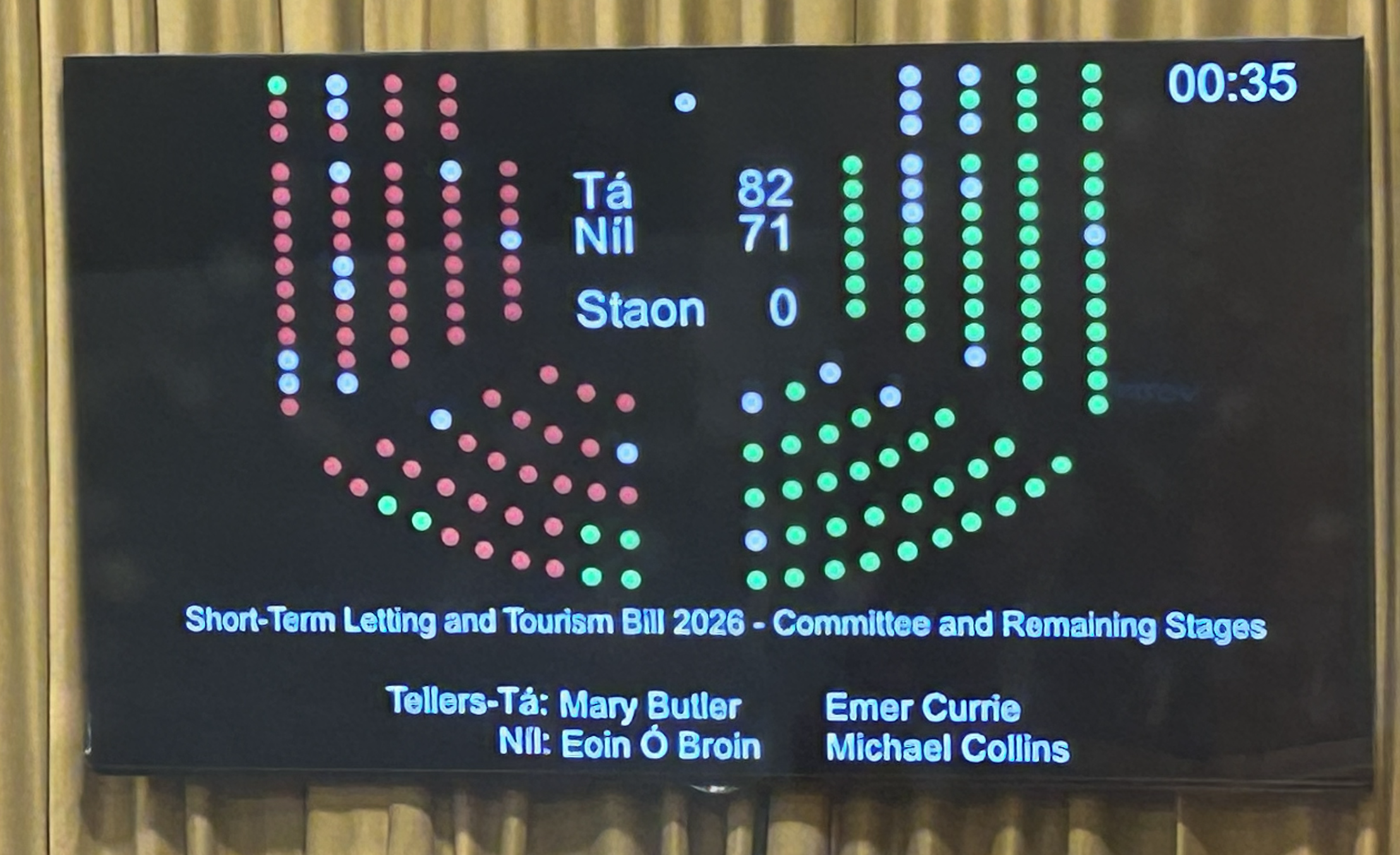
The Short-Term Letting and Tourism Bill 2026 was guillotined in the Dail on 11/11/2026 and no amendments were accepted by Minister Burke.
The National Planning Statement for STR was approved by the Cabinet last week with no discussion in the Dail, and the Housing Committee had not completed their work on the legislation. Much of parliamentary commentary on the STLT Bill was about the issues with planning policy.
There has been 10% growth in the sector year on year, and this cannot be passed unchecked according to Minister Burke. Is this based on Eurostat Data or other sources as the fundamental problem with the discussion was the lack of existing STR Data. It could have been different.
There could have been data to work with but unfortunately the original Register for STR was cancelled by the Government in 2008. Today’s traveler’s choice of holiday accommodation has changed, particularly since Covid, and this is reflected in the move away from hotel beds for longer stays.
As a rural TD Minister Burke has said that he is ‘trying to balance the rural economy and accessible accommodation is challenging and we do not want to create unintended consequences for the tourism sector’. He wants to allow a process for towns with a population above 20,000 with a planning requirement to get on the Register.
On Wednesday, over a 4-hour period, TDs stood in the Dáil to describe how much they support RuralIreland and tourism, however motions on changes to the STLT Bill were not accepted. George Lawlor TD identified over 12 errors in the document and said a law must be accurate when approved by the house. As the amendments of the Committee were not included in this bill, the discussion often focused on areas which would otherwise be resolved at Committee stage.
Rory Hearne TD stated that ‘‘the new planning laws were in place since 2019 when introduced by Eoghan Murphy TD. There were only 426 applications for STR planning since then and only 186 granted’’. He did not mention the Rent Pressure Zones which prevented planning approval and the ‘Housing for All’ policy which works against provision of STR planning. This is why the planning regulation did not work. As the presumption is against planning most owners were waiting for an Irish Solution to a planning mess caused by a previous Housing Minister.
Sinn Fein repeatedly stated the importance of rural self-catering to family income (the Mom + Pop) as compared to the large corporate companies which the Government should be tackling. Sinn Fein had5 amendments to the bill, which were all defeated by Government votes.
‘To Regularise planning applications is no walk-over’ said Richard o Donoghue TD, who hasexperience with planning from a building perspective. According to Mr. O’Donoghue to try to get an Engineer or architect in the next 6 months will be very difficult. How can a building built before 1963 get a change of use planning, if it never had planning as a building before he asked.
As the 4-hour debate went on Michael Healy Rae TD became increasingly frustrated as he had 70 amendments to the Short-Term Letting and Tourism Bill, all relevant to the continuing of holiday lets in Ireland. “We are an hour and a half into 71 amendments, and we are on amendment No. 2. Unfortunately, not much progress was made in addressing every amendment and Deputy Healy Rae did not get any of his amendments discussed on Wednesday.
Niamh Lunny, CEO of Irish Landmark Trust said “A proportionate and workable Bill must recognise that not all short-term rentals can or will become long-term housing. As currently drafted, it fails to do so and risks causing irreparable damage to Ireland’s smaller, authentic accommodation providers, undermining heritage buildings, agritourism enterprises, rural communities and the micro-economies that depend on visitor income. I urge Ministers to amend the legislation so that it delivers transparency without sacrificing the diversity and sustainability of Ireland’s tourism sector.”
Noelle Casey, Chairperson of the ISCF said “Self-catering has been in existence for decades in Ireland. We welcome a Register but the Irish government, unlike every other European country, has decided to attach planning permission as a prerequisite to be able to enlist on it. The priority should be to set up a simple Register without obstacles to owners in order to gather the data necessary to plan for the future of sector and make decisions on evidence about balancing the needs of housing with the needs of the tourism sector and rural economies.”
‘The Government is rushing through a STLT Bill, without clear consultation with the industry. We need the Register for STR for clear data to enable us to make the correct decisions moving forward’ said Maire ni Mhurchu CEO ISCF. We also have to consider the need for a Register and the ECJ ruling on the Smartflats case. Based on Eurostat data STR is growing in Ireland, but not the number of units. Most guests (75%) stay outside the capital city. Neither Eurostat nor any other source has provided data on how many properties would return to long-term housing from tourism if these restrictions were introduced.
ENDS
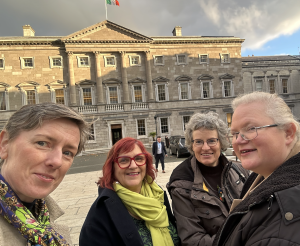 ISCF oard Members at Dáil for 2nd stage vote
About the Irish Self Catering Federation
The Irish Self-Catering Federation (ISCF) is the national representative and lobbying body for owners of self-catering properties in Ireland. Established in 1998, ISCF advocates on behalf of its members to promote and develop the interests of the self-catering sector across the country.
The ISCF has called for a Register for STR since 2017. Recognised by Fáilte Ireland, local andcentral government, and key tourism stakeholders, the ISCF works to ensure that self-catering accommodation providers have a unified voice in policy discussions and industry developments.
The federation represents a diverse range of property owners, from individual holiday home operators to larger agencies and groups. In addition to national advocacy, the ISCF is amember of the European Holiday Homes Association (EHHA), engaging in discussions and policy development at the European level to support the self-catering industry.
ISCF Conference takes place at Killashee Hotel on 23rd November 2026.
For media enquiries:
Contact the ISCF office, which co-ordinates all interview requests.