
Member’s Concerns: The Short-Term Letting and Tourism Bill 2026 (no 1)
In light of the Short-Term Letting and Tourism Bill 2026 the ISCF asked members for comments. This is a compilation of comments and it is the only way SME owners can give their views and we welcome all self-catering owners to send views to info@iscf.ie. In each case ‘the member’ refers to comments of the ISCF holiday lets owner who will be impacted by this bill, and the associated planning requirements. The government has not followed parlementary procedure by
- Issuing the Short-Term Letting and Tourism Bill 2026 was announced by Press relsease on 6/10/2026, and the details of bill not published until 23/10/2026.
- The Short-Term Letting and Tourism Bill 2026 was issued before the Joint OIreachtas Enterprise Tourism and Employment had approved the bill.
The members have raised serious concerns about the proposed legislation, questioning its fairness, proportionality, administration and potential legal validity. They are particularly concerned about the impact on established self-catering businesses, rural tourism and the lack of consistent national planning criteria.
Key concerns raised
- No exemptions for established businesses – The member’s believes there are no provisions exempting businesses with seven or more years of trading, despite previous communications suggesting this had been secured They argue that established businesses and new entrants are being treated equally, regardless of their investment, trading history or circumstances.
- Restrictions on businesses offering multiple services – The Bill is understood by the member’s to prevent businesses from registering across multiple categories. They argue this undermines diversification, limits customer choice and threatens the financial viability of businesses offering several types of accommodation or tourism services. At the same time it is trying to impose hotel style rack rate displays. This indicates a copy and paste from hotel legislatio n
- Unclear powers and accountability of the competent authority – The authority refered to in the legisaliton is Failte Ireland who have the responsabilty for the Registration system. The member’s questions how the authority responsible for registration will be appointed, what qualifications it must have and who will oversee its decisions. They are concerned about the absence of transparent competency criteria, ongoing supervision and accountability. They also question the authority’s ability to impose charges without clearly defined fees or oversight.
- Annual registration and uncertainty for businesses – The proposed 12-month registration period could create difficulties for businesses seeking bank finance, maintaining existing loans and planning future operations. The member highlights the lack of guaranteed processing times and the risk of registration delays affecting the ability to trade. This is particularly problematic for properties taking bookings more than a year in advance, including accommodation associated with weddings and other major events.
- Financial penalties and booking cancellations – The member raises concerns about a provision they understand to require hosts who cancel bookings to pay the agency the full booking fee, rather than just the agency’s commission. They believe this could impose disproportionate financial liability on hosts where future registration or permission is uncertain.
- Access to financial records and personal information – The member considers the proposed powers to access records and accounts excessive for small accommodation providers, including family-run B&Bs, glamping, agritourism and micro female lead family businesses. They question the safeguards governing these powers and whether they are proportionate to the nature of the businesses affected.
- Appeals and legal protections – The member believes the appeals process provides insufficient time and places excessive documentary and financial burdens on those challenging decisions. They question whether adequate protections, access to legal representation and meaningful oversight are available to affected businesses. They believe aspects of the Bill may be open to legal challenge, although this would require independent legal assessment.
- Inconsistent planning decisions across local authorities – The member is particularly concerned about the absence of consistent national criteria for planning decisions. They cite their own experience with local planners in Sligo, alleging that their circumstances and existing planning guidance were not properly considered. They question why a business in a very small rural community should face restrictions justified by population thresholds or housing pressures that may not reflect local conditions. In Westport a tourism focued town planning for a Short-term let in a property too small for long-term occupancy was turned down. While in Kilkenny any property in the town applying for planning under the town renewal scheme seems to be getting planning, changing the character of the town.
- Impact on rural communities and local economies
The member strongly disputes the suggestion that short-term rental accommodation offers little benefit to local economies. They explain that they restored a derelict properties without government grants, created local economic activity and direct business for local tradespeople. They also encourage guests to support nearby pubs, shops, markets and tourism attractions. They work with local marketing agencies to bring more guest to the rural community throughout the year. The central argument is that short-term letting supports rural employment, local businesses and tourism spending, particularly in areas with very small populations and limited alternative accommodation.
3 Urban Areas
The proposals in planning restrictions for Short-Term Rental in the bill is based on a National Plannign Statement which was not issued before or at thim of publication of the STLT bill. The list of areas where the populaiton was over 20,000 is listed in the Bill as an arbitary reason for not allowing Short term rental, holiday lets, glamping or other SME businesses. At the same time there is a list of properties listed as a hotel where accommodation and other serices are priovides on the premesis on a register of hotel . These include a motel, a restort, an apartment hotel, an Apartotel, aparthotel, microtel as prividing hotel accommodation and services. This removes arbitrarily the ability of micro businesses to develop.
The towns where short term rental in any form will not be allowed in future, and serioously limit by planning those already in business are
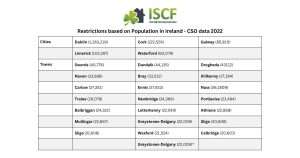
The populaiton of Delgany was 7,707 and Greystones is the municipal district. This is the only combined village district in the 20.000 population. What happens when the populaiton of a town goes up at the next Census in 2027 – will there be more town restrictions? The populaiton restrictions is the most sever in the EU.
The European Court of Justice Smartflats Ruling 22/10/2026 judgment makes clear that an authorisation scheme cannot be justified in the abstract, requiring a causal link such as an objective study or analysis demonstrating that STRs have a significant effect on the residential housing supply and/or on rental prices. The Court ruled that such schemes are only justified where, taking into account their geographical scope and their impact on residential needs, they are necessary and no less restrictive measure would achieve the same objective.
Note
This is a compilation of comments and it is the only way SME owners can give their views and we welcome all self-catering owners to send views to info@iscf.ie. We reserve the right to edit, amend and balance the comments made
About the Irish Self Catering Federation
The Irish Self-Catering Federation (ISCF) is the national representative and lobbying body for owners of self-catering properties in Ireland. Established in 1998, ISCF advocates on behalf of its members to promote and develop the interests of the self-catering sector across the country.
The ISCF has called for a Register for STR since 2017. Recognised by Fáilte Ireland, local andcentral government, and key tourism stakeholders, the ISCF works to ensure that self-catering accommodation providers have a unified voice in policy discussions and industry developments.
The federation represents a diverse range of property owners, from individual holiday home operators to larger agencies and groups. In addition to national advocacy, the ISCF is amember of the European Holiday Homes Association (EHHA), engaging in discussions and policy development at the European level to support the self-catering industry.
ISCF Conference takes place at Killashee Hotel on 23rd November 2026.
For media enquiries:
Contact the ISCF office, which co-ordinates all interview requests.